The year in Ireland my family never forgot
In August 2014 I moved with my six children to Lismore in County Waterford. It became one of the richest years of our lives. And it ended with a single email.
We were standing on a campsite in Vienna, in the middle of the summer holidays, when the email came. My landlord in Ireland. Offhand, three sentences: Don't come back. We're moving back in ourselves. Tell me where to have your things sent.
Our whole life was in that house. The children's school things, the photographs, the larder we had built up over months. And I stood fifteen hundred kilometres away beside a camper van and read those three sentences again and again.
But let me tell the story from the beginning.
Ireland was never the plan
Because there is something you need to know before this story properly begins: Ireland was on no list in my life. No boyhood dream of the Emerald Isle, no long-held longing. Ireland came to us the way the most important things sometimes come: at the end of a long line of losses.
In 2013 I was divorced in the United States. You won't read much about that divorce here; some chapters don't belong on the internet. But it pulled the ground out from under our life. And while that chapter was still closing, the next one shut too: my visa ran out. I had to leave America, the country that was our home, the country my children had grown up in. It was no departure. It was an eviction. A door that others closed behind us.
We went to Malta. Not because Malta had been a dream, but because we had to be somewhere. Malta was meant as a stopgap, a waiting room: arrive, catch our breath, prepare the return to the States. Back across the Atlantic as fast as possible, that was the whole plan. What that waiting room really looked like, a flat above the marina in St Julian's and a brother who caught us when we fell, I tell in my Malta story.
The quick return never happened. After about a year we left Malta again. We spent the summer of 2014 in the States once more, one whole long summer in the country that still felt like home and was no longer allowed to be.
And then: Ireland.
If I am honest, Ireland too was first meant as a stopover: gather ourselves, sort things out, save our strength for the return to America. I'll come back to that later.
So in August 2014 I arrived on the Emerald Isle: divorced, without a home, tired of packing suitcases, six children in tow and no plan worth the name. Perhaps you understand now why this one year in Lismore was more to me than a pretty chapter. When you have just lost everything, you recognise a new life the moment it lies in front of you.
Lismore
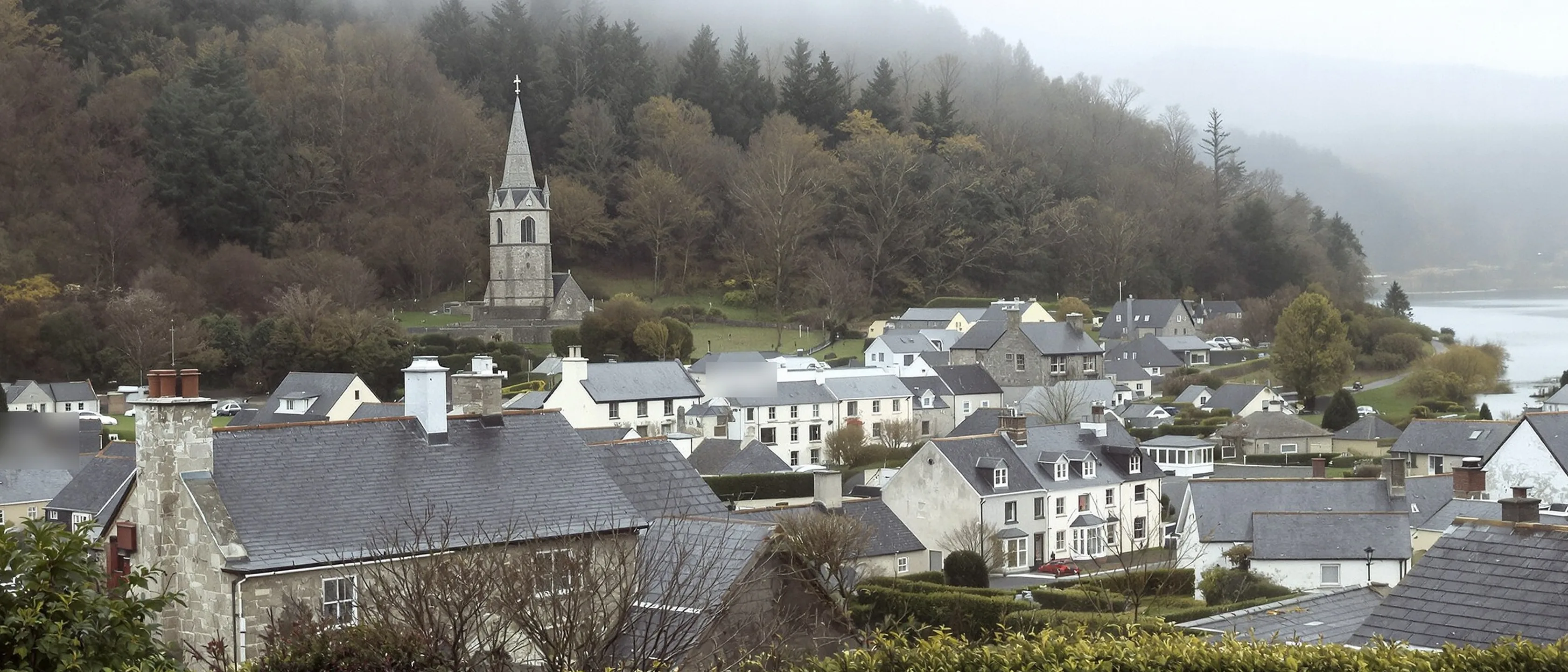
Lismore lies in the west of County Waterford, where the road crosses the Blackwater and the Knockmealdown Mountains begin behind it. Cork is a good hour's drive. As for Dublin, best not to drive there at all: you have no business there. The town itself: one main street, one cathedral, one river. A little over a thousand people. And in the centre a plaque the town is proud of to this day: Tidy Towns Award 2004. The most beautiful town in Ireland. The President herself came back then to unveil the plaque.
Above it all rises a castle straight out of a picture book, still lived in to this day. And not by just anyone. Lismore Castle has been the Irish seat of the Cavendishes, the Dukes of Devonshire, one of the most powerful noble families in England, since 1753. Their family seat is Chatsworth House in Derbyshire, and in Lismore the branch of the family that goes by the name Burlington lives today. When Ireland became independent, the English landed gentry vanished from almost everywhere on the island. Not here. The family kept the salmon rights on the Blackwater, which runs straight through their estate, and it held on to a good three thousand hectares, forest, pasture, a piece of mountain. Salmon fishing on the Blackwater is among the best in the world. A hundred years of the Irish Republic, and anyone who wants to fish there still gets their licence from the Duke. That is how much power these families still have in Ireland.
A small town with a castle, a river and a single main street. Anyone who comes from London, from Frankfurt, from Zurich understands after two days in Lismore: they have not landed in another country. They have landed in another time.
That was exactly what I wanted.
Seven bedrooms for 750 euros
We didn't move into some terraced house. We rented an eighteenth-century Georgian country house with a good hectare and a half of land, right at the gates of Lismore. Seven bedrooms, furnished in the style of the period, and all of it badly in need of repair. That was why the rent was a gift: 750 euros a month.
What was written on no piece of paper: keeping the house warm cost another thousand euros on top. Every month.
The owner had started renovating years before, the neighbours told us later, and then the money ran out. You could see it everywhere. The once pink paintwork had faded to a tired grey. Half the radiators stayed cold. We heated the living room and the drawing room with open fires. The wallpaper peeled where the damp sat in the walls. The old grand piano in the drawing room no longer played. There was no shower, but there was a Victorian bathtub a grown man could swim in.
And yet: it was the first house we looked at after arriving in Ireland, and after weeks of driving across half the country in a hire car and viewing a dozen others, the children and I agreed. It will be Lismore. It will be this house.
Of course I was afraid the children would wreck the antiques. I took the risk. When life opens a door like that for you, walk through it. When will you ever live in a house like that again?
Only one thing I would do differently today: before moving in I would not look at the rent but at the fabric of the house. Windows, roof, damp, energy rating. The rent is in the contract. The heating bills are written nowhere, and in Ireland's old housing stock they are the real issue. For us, the winter cost more than the living.
No deposit, no contract, no problem. Or so I thought.
The owners lived abroad and wanted the house let at any price. I paid no deposit. I signed no lease. That is still often how it works in Ireland today, especially in the countryside, especially with houses in private hands.
At the time it seemed wonderful. No paperwork, no credit file, no agent. Keys, handshake, move in.
I had no idea that exactly this ease would cost us our home a year later.
A life without a car, without a supermarket, without noise
I wanted to slow down. Fewer appointments, less noise, less of everything. And that is exactly what I got.
We had no car. In rural Ireland that borders on madness: no station in the town, one bus to Dungarvan, once a day, that was the entire public transport. The nearest proper supermarket: Dungarvan, half an hour's drive. In Lismore itself there was a small Centra for the essentials, a handful of quaint Irish pubs, a gastropub that of all people belonged to a Texan couple, a hairdresser, a butcher with a legendary reputation. And the chipper, of course, the fish and chip shop.
That was it. No chains, no fast food, no cinema, no gym.
So we arranged our life around it. We stopped eating out, with one sacred exception: Sunday roast at the gastropub. I cooked every evening myself. We wrote meal plans for a whole month, hired a car once a month and shopped in Dungarvan as if we were provisioning an expedition. The larder grew. Everything fresh we bought in the town.
Sounds like going without? It was the opposite. It was the first time in years that our days belonged to us.
Only one thing I tell everyone today who wants to move to the Irish countryside: out there a car is not a comfort, it is infrastructure. The bus may run. But it does not run when your child needs the doctor.
The children blossomed
What carried me most in that time was how well the children were doing. They all went to school in Lismore, in the middle of the town, within walking distance, and they went gladly.
I had told the teachers what kind of situation we were in. And those teachers looked after my children as if they were their own. No form, no case file, no fuss. People simply helped. I had that experience in Ireland again and again, but never as clearly as at those schools.
The children made friends, and the small town helped a great deal. When all the children of one year sit in the same school and live in the same town, a social life grows by itself: playdates, parties, bicycles at the door. At the same time the schools demanded something, academically nobody was coddled there, and that was exactly what did our children good, after years of fairly unconventional schooling.
For families from the Continent, this is the point where Ireland beats almost every other destination: your children go to an ordinary state school, in English, with no fees, in the town. After a year they speak English like the children at the next desk. And if you would rather teach your children yourself: that too is a recognised path in Ireland, not a running battle with an authority.
Carmel, and the priest on the bicycle
And then there was Carmel, our housekeeper. Carmel was from the town, had raised a family of her own and wanted to earn a little extra. An Irish original: loud, funny, indestructibly cheerful. She worked for us full time and took my children under her wing as if they were her own. Her cleaning was, let's say, more heart than system. I couldn't have cared less. That year, a big heart mattered more than dust-free shelves.
And Carmel was no exception. The whole town took us in, with a warmth I have not forgotten to this day. No one embodied it like the parish priest, Fr Cullinan. He came to the house on his bicycle, unannounced, naturally. Leaned the bike against the wall, knocked, and then we sat for an hour or two over tea. A quiet, kind man who cared about his people, and to him we belonged among them as a matter of course.
I often went to Mass during the week and afterwards walked for hours through the countryside. Around Lismore there are endless paths. When a hire car stood at the door, I drove further out: to the cliffs of Ardmore, up to Mount Melleray, to the Cistercian abbey in the mountains.
The other side belongs to the truth: in a town of a thousand people everyone knows everything. If you are looking for anonymity, you are lost in a small Irish town. If you are looking for neighbours, you have found them.
The practice kept running. Better than ever.
My practice ran without interruption throughout that whole time. But I made two decisions that swept my diary clean.
First: no more free initial consultations. In our line of work everyone talks to everyone for free, for hours, and calls it sales. I switched to paid consultations at a high hourly rate. Most enquirers waved it away. But the ones who paid were the serious ones. The old 80/20 game: find the twenty per cent who carry the weight. And revenue? It didn't fall. It held steady and rose over time, because better clients walk a longer road with you.
Second: I took on an experienced assistant and handed her my inbox. Email is a vampire. It eats time and energy and gives nothing back. That one handover freed me like little else.
And suddenly there was time. Time to write content for my website, which brought new business. And time for something that otherwise never appears in an entrepreneur's diary: walking for hours and doing nothing but think. "Wasting" time on thinking is a privilege, I learned that in Ireland. And no country invites it like this one: the landscape there thinks along with you.
Along the way it turned out that Ireland works better as a base for an international practice than most people believe. English as the working language. A time zone that catches Europe in the morning and the American East Coast in the afternoon. Airports in Cork and Dublin. And a country where nobody frowns when your clients sit in five countries.
Time to sort through the wreckage
Today I know how much I needed that pause. Because there was enough to work through.
The divorce was a year behind me. There I stood, alone with six children. A broken family does not stop hurting just because the proceedings are over. I did not speak to my ex. Establishing real, regular contact between her and the children, even just by phone, proved impossible. They were confusing times for everyone, and I lay awake at night asking what more I could do for the children.
And I did not fool myself: a single parent is not a couple. A father does not replace a mother, any more than the other way round. Anyone who looked honestly knew: no one comes out of this unharmed. I could only limit the damage. That realisation broke my heart.
Heaviest of all weighed my eldest son, the seventh. He had stayed in America, and he was stuck there, with no prospects. No training, no university, no proper job, only odd jobs for cash. A boy with a brilliant, academic mind. It tore me apart to watch that waste from far away.
Eighteen months: nothing. No answer, no call, no sign. He was full of anger, and he did a good deal to put distance between us.
I wrote anyway.
A German nun I have known since my childhood gave me a piece of advice back then that I clung to: keep making it clear to him that a happy home is waiting for him, whenever his time has come. So that is exactly what I wrote to him, in every email that went unanswered. And he could see what our life looked like, because the other children and I regularly posted pictures from Ireland on Facebook. I lived on the hope that one day I would get my son back. Even if it took ten years.
On top of that, the loss of the ranch in Texas, the one place that had ever felt like our true home. My daughters' tears when we left it for good that summer, I saw them before my eyes every single day.
The decision to look forward
At some point you reach the place where grief tips over into self-pity. Count only your losses and you miss what is lying right there on the table. After a few months in Lismore I made a conscious decision: enough. From now on we count what is there.
And there was a lot. Children who liked going to school in the morning. Friendships that grew. Carmel in the kitchen, the fire in the hearth, the priest on his bicycle, the paths along the river. A life that was slowly becoming ours again.
The email I had waited eighteen months for
And then, on a perfectly ordinary day, there it was in the inbox: an email from my eldest son.
He wrote that he had had enough. Enough of his life in America with no prospect of anything. He wanted to come back to Europe, train for something, build something. Could we talk.
I sat there and read the lines three times, four times, and inside me joy and disbelief tumbled over each other. What had happened? Why now, after eighteen months of silence?
The answer came later, in our conversations, and it was disarmingly simple: nothing. No trigger, no revelation. He had needed time. Time to come to terms with his parents' separation, and time to find out what he himself wanted from life. The nun had been right, in every word.
A few weeks later I flew to the States and drove to the farm near Washington where he was working. When we hugged in that farmyard, it was one of the happiest moments of my life. We spent a wonderful week together, in Virginia and in Texas, and agreed: in the summer he would come to Europe. I flew back to Ireland with a heart full to the brim.
Texas remained the plan
Because one thing was never in question for me: Ireland was the base. Gather, recharge, put my strength in order. The goal was Texas, a new ranch, the return.
So I used the headroom I had won for thinking, and I planned. I looked at ranch properties, ran the numbers on financing, turned the visa question over and over. I told the children openly about it, because I had promised them that one day we would go back, and I wanted them to know: Dad has not forgotten. Looking back, it unsettled them more than it reassured them. Children need the next school day, not the ranch in five years. I know that today.
But for me this vision was an anchor. I threw myself into it with everything I had. Country music played from morning till night, in my headphones on the long walks. And when "The Way She Loves Me" by Cody Johnson came on, I dreamed of the one woman with whom I would start all over again. A cowgirl, a Southern belle, somewhere out there. Some day. Somehow.
I listened to American audiobooks, Zig Ziglar over and over. I read about farming and ranching. I looked at Irish grazing land and stood at cattle marts among farmers who had stood there for five generations.
To be honest, little that was concrete came of it all. And yet those days are among the richest of my life. There I lay on the divan in the drawing room of my country house, Carmel putting more wood on the fire, country music playing in the background, and I forged plans for a great future. What a life, I thought. And a few more years of this, please.
It turned out differently.
Thrown out like dogs
Back in Ireland the summer holidays of 2015 began, and I wanted my children to see what one has to have seen of Europe while we were still here. We loved road trips, so we hired a camper van: five weeks, right across the continent. Berlin, then Austria, Italy, France, Spain. Vienna, Ravenna, Venice, Rome, Marseille, Nice, Barcelona. Whether the children appreciated the cultural treasures is another matter. I loved opening up this old Europe for them, every single day.
And then, in Vienna, the email. The landlord, as agreed, was in the house with his family over the summer. And now he wrote to me, in passing, as if it were about moving an appointment: we should not come back. He was unhappy with how we had treated the house, and besides, they were moving back in themselves anyway. Where might he have our things delivered.
I felt as if someone had punched me in the stomach. After the early farewell to Malta, after the loss of the ranch, barely arrived in Ireland and just come to rest, we were put out on the street like dogs dumped at a motorway services on the way to the holidays. Our clothes, the children's toys, our whole life, wound up in three sentences while we stood on a campsite.
Yes, I had my share in it. There was no contract, and I was too trusting in dealing with landlords. The complaint about how we had treated the house was an excuse, he knew it, I knew it: years of neglect had run the house down so far that there was nothing we could have made worse.
And then I could not find a second house in all of Lismore
My first thought was defiant: fine, then we'll rent another house in Lismore. Still on the campsite, I combed the Irish property portals. A comparable house was out of the question, fine. Any house. Four walls, a roof, a walk to school.
There was none. Not one.
And this is the lesson that reaches beyond my story: Lismore is not an exception, Lismore is Ireland. In rural Ireland renting is the absolute exception. There are no professional landlords, the stock is individual houses in private hands, and whatever comes free goes under the counter, often without a single advert. A town of a thousand people has no rental market. It has chance.
And everything then hangs on that chance. Your children's school. Your doctor. Your neighbours. Your whole, painstakingly built everyday life. For us it hung on the mood of a man who lived abroad and disposed of us by email.
In the days that followed, the feeling of betrayal ate so deep that I no longer knew whether I even wanted to go back. Ireland had been beautiful, but it had always been meant as a stopover. So why not do the thing properly and push ahead with the return to the States? We were not as far along as I wanted to be, a ranch was not yet within reach. But perhaps all of this was a sign from above: stop dreaming of America on your walks. Do it.
I reckoned on a year for the visa and the preparations. That left the question of where to spend that year. I rang my brother and asked his advice. His answer: why not go to Malta for a year. Why not, I thought. That this one year would become a second Malta, this time with a house instead of a flat and a proper school instead of lessons at home, I had no idea that evening.
Two children stayed
And then something happened that says more about Ireland than any statistic in this text: two of my children did not want to come.
My eldest daughter refused to leave Lismore. Not the school, not her friends, not the town. So she stayed, with a host family in the middle of the town. Read that sentence twice if you like: a small town where we had arrived as strangers a year earlier took my daughter in as one of its own. That is Lismore.
My second son was drawn the other way, to the capital: he wanted to go to a boarding school in Dublin. Ireland has a long boarding school tradition, venerable houses with uniforms, rugby and strict house rules, and these schools are among the best the country has to offer. He went, and he flourished there.
So overnight our farewell to Ireland became half a farewell.
Blackrock and Rathmines
Because now I had two children on the island, and I needed a base. If I am honest: I wanted one, too.
I rented an office in Blackrock, south of Dublin, right on the coast. Blackrock is really a village the city swallowed at some point: a market, a main street, the DART rattling along the sea into town, and at lunchtime you walk by the water with a view across the whole of Dublin Bay. That was where my desk stood whenever I was in the country.
I lived in Rathmines, Dublin 6. A studio was all I needed. Rathmines means red-brick terraces and the green dome of the church above the rooftops, cafés, bookshops, lots of young people, and you walk into the centre in half an hour along the canal. If you want to see Dublin at its best, start right there.
For years I commuted like that, back to the island again and again, to the children, to the desk in Blackrock, to the studio in Rathmines. Only around the pandemic did I give up both, the office and the flat.
And now the confession: much as I liked Blackrock and Rathmines, I never found the happiness of Lismore there again. Dublin is a capital like other capitals, expensive, loud, interchangeable on some days. The Ireland that caught us back then is found in the small towns. That is why today I bring clients for my seminars to the country around Cork. Never to Dublin.
What I learned in Ireland
Today I send clients to Ireland, to exactly this corner of the country. From Lismore I take five things with me, and the first is the most important.
Buy. Don't rent. If you come from a country where renting is the norm and buying is the adventure, that sounds the wrong way round. In Ireland it is exactly the reverse: renting is the difficult, fragile, nerve-racking part, across the whole country and not only in Dublin. Buying, on the other hand, is affordable outside Dublin and surprisingly straightforward. If you come with children and want a school, a town and neighbours, you buy. Everything else means: your life hangs on a stranger's email.
If you do rent, get it in writing. Without a contract you are nobody. The easy move-in without a deposit and paperwork is the same mechanism that throws you out of the house in July.
Count the heating, not the rent. Ireland's old housing stock is easy to fall in love with and often miserably insulated. Energy rating, windows, roof, damp: check first, then fall in love.
Get a car. In the countryside it is not a question of comfort.
Choose the county first, then the town, then the school. The South East between Wexford, Waterford and Cork is drier and sunnier than the west, well connected and full of small towns where a family arrives in weeks, not years. That is not theory. That is the priest with the bicycle in our drive.
What remains of Lismore
We did not go back to Texas, at least not that year and not by that road. The one year in Malta became something else. And the boy who had been silent for eighteen months became a man with training and a profession in Europe.
Ireland is not perfect. The weather is what it is, Dublin is absurdly expensive, the rental market is a sorry affair. But the sum of things is astonishingly attractive: an attainable EU passport. A neutral country outside NATO. State schools in English, with no fees, where your children flourish. A mild climate. Tax rules that look kindly on newcomers with foreign income. And small towns where a family is a gain and not an administrative case.
If I did it again, I would choose the same corner, perhaps even the same road. I would do only one thing differently: buy.
How a family with five children fared is told by Marc Vogler. His story