You are not looking for a better country. You are looking for a better life for your children.
It is late. The children have long been asleep. And you are still sitting at the kitchen table, reading the news again: war in Europe, rearmament, debates about conscription. You look over at the door of the children’s room, and there it is, the one sentence you hardly dare say out loud: My children will not become their cannon fodder.
I put it this bluntly because it is the most common reason families come to me. Not tax. Not the sea. The fear that one day their sons will be made to pay for other people’s warmongering. If you have a son, you read the news differently today. And if you are honest, you stopped looking for a better country a while ago. You are looking for a place that keeps your children out of it.
Ireland has no conscription. Ireland belongs to no military alliance, NATO included. Ireland lies on the western edge of Europe, as far from the sabre-rattling as you can live and still be in Europe. That is no guarantee, and I promise you none. But it is an entirely different starting point for your children.
And if that one reason brought you here, there is more behind it: more freedom over schooling. A second passport, and an EU one. English as the language of everyday life. A place where your children still grow up as people, not as numbers. I will tell you straight away: on none of these points is Ireland, on its own, the obvious answer. There are cheaper corners, sunnier corners. But hardly any other country in Europe brings all of these points together. That is what this page is about: the sum.
It is written for you if you are coming from the UK, from Scandinavia or the Low Countries, if there are still children around your table at home, and if there is capital from a business or the sale of a house. Because that is exactly the position that changes everything in Ireland: the safe harbour, the passport, the reversal in the property market and the region from Wexford to Kinsale.
And one more thing before we start: this decision has a window, and it has nothing to do with legislation. Your children will not wait. Every year you spend weighing it up is a year of childhood that does not come back. A move that would be an adventure today will, at some point, no longer be one.
Ireland loses almost every single comparison
Let me tell you something you might not expect from someone who has spent years helping families move to Ireland: Ireland wins almost no single comparison.
You want sunshine? There are countries with three hundred sunny days a year. Ireland has clouds that look as if they have taken out a season ticket. You want a low cost of living? There are places where you can live on half. You want snow-capped peaks, glittering cities, seafront promenades lined with palms? You will find all of that elsewhere, and better.
Anyone who emigrates by spreadsheet, row by row, criterion by criterion, crosses Ireland off at some point. I have seen those spreadsheets often enough. Neatly kept, colour-coded, three countries on the shortlist. And I have watched the same families sit in Ireland two years later anyway, at the kitchen table of a house they own, while the children played football outside in the rain and nobody minded.
Because a spreadsheet cannot do one decisive thing: it cannot add up what belongs together. A life is not made of twelve separate criteria. It is made of a single day that keeps coming round. And that day is what you have to look at as a whole.
A Tuesday in the south-east
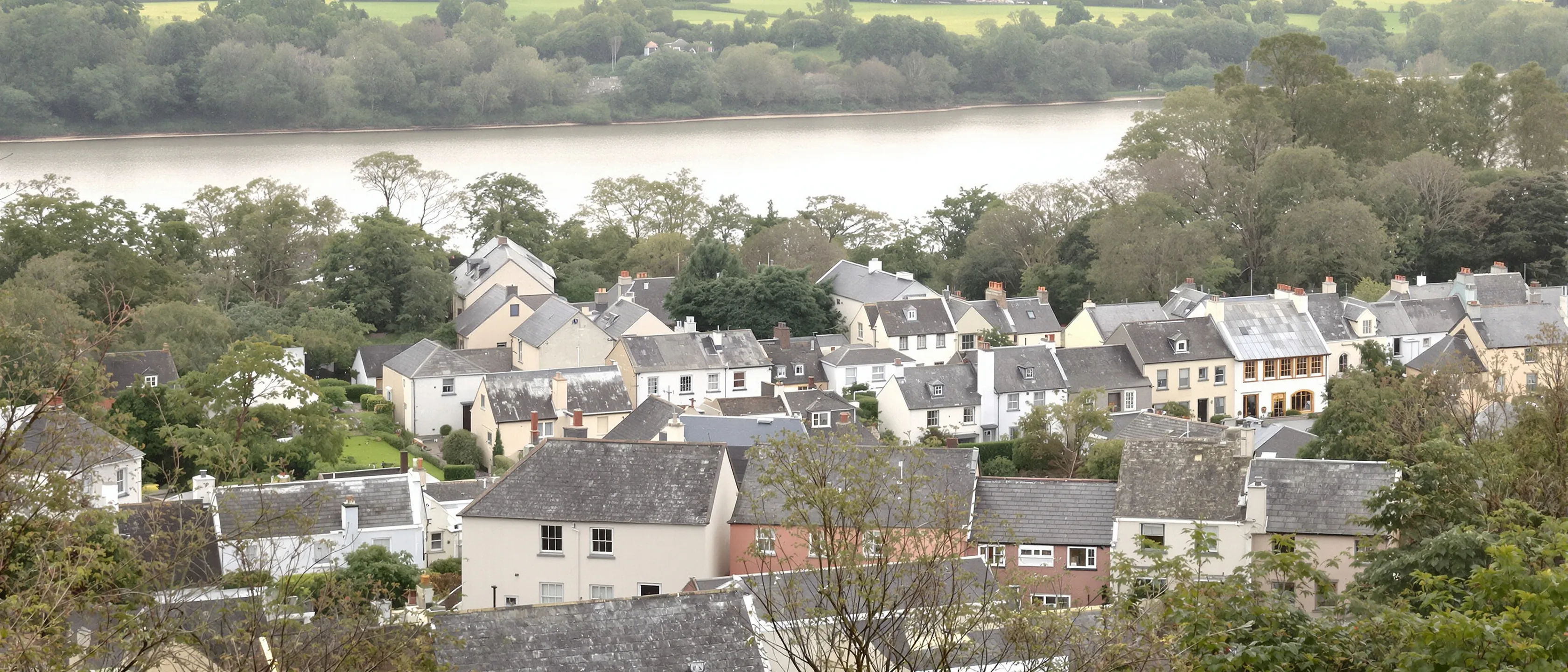
Picture it, this Tuesday. Somewhere between Wexford and Kinsale, in a small town by the water.
In the morning your children go to a school where they speak English like a second mother tongue. Not a textbook language, but the language they will later study, work and negotiate in, anywhere in the world. Or they do not go to school at all, because you have decided to teach them yourself, and the Irish Constitution expressly gives you that right. No official turns up at your door. No proceedings loom. English law allows home education too; in Sweden it takes exceptional reasons. Here it is a constitutional right.
You walk them there. The woman in the shop knows their names. The neighbour raises a hand. It sounds twee, I know. It is still true, and it is one of the reasons families stay: in a small Irish town a child is still a child and not a case file.
At midday the sun may be out, or it may not. The south-east is the mildest corner of the island, with a relatively dry climate, but yes: it rains. In return there are no forty-degree summers, no minus twenty in winter, no wildfires, no drought. The grass is green all year round. You get used to it faster than you think, and at some point you find yourself defending this weather against every visitor from home.
In the evening you sit in a house that belongs to you. Not rented, not tolerated, not something you can be given notice on. Bought, with a garden, often with a view of the water, at prices that would make many a Londoner or Amsterdammer check twice whether they read them right. And as you sit there, you know two things that cannot be measured in money: this country has no conscription, and it belongs to no military alliance. Your children are growing up on the western edge of Europe, with the Atlantic at their backs.
That is the Tuesday. No single thing about it is a sensation. The sum is.
What only comes together here
Now turn the thought experiment around. Take the things that really count for a family from the UK, Scandinavia or the Low Countries, and look for the one country that offers all of them:
A state that sits one level further away. In Ireland most of what shapes your day is settled in the community: the school, the club, the neighbour. The Constitution can only be changed by referendum. And as a British or EU citizen you register with no authority when you arrive. Smaller state, closer community.
Neutrality. No alliance, no conscription, a safe harbour on the edge of the continent. I promise you no guarantees; nobody can give them. But your sons’ starting position here is fundamentally different from what it is inside NATO.
English as the language of everyday life. An English-speaking EU country, where your children grow up without you having to buy them the world’s language at great expense.
Freedom in education. Good state schools and, alongside them, as a real right, teaching at home. You decide how your children learn. Not the state.
That this works for more than a single father is shown by Marc Vogler. He came to Ireland with his wife and four children for a year out, the fifth was born here, and the children did not want to go back. Today he advises families who are weighing up the same step. His story
A tax system that welcomes newcomers. If you are not of Irish origin, you will find room to plan in Ireland that you can only dream of at home. Legal, established, part of Irish law for generations.
A property market that rewards buyers. Renting is hard everywhere in Ireland, and I will not hide that from you. But buying outside Dublin is surprisingly doable, and for a family with capital from the sale of a business or a house, that turns everything around: you do not arrive as a supplicant on a rental market. You arrive as an owner in a community.
And in the end, perhaps, an Irish passport. Not bought, but earned, through a real life in the country. An Irish passport is one of the strongest in the world. How long the road through naturalisation will take in future is being decided by the Irish parliament right now, which is why it stands down here and not at the top.
Now strike out one of these points and look for the country that offers the rest. Strike out the passport: you end up outside the EU. Strike out English: your children start out behind. Strike out neutrality: you read the news again with that knot in your stomach. Strike out ownership: you remain a guest in your own life.
There are sunnier countries, cheaper countries, more spectacular countries. There is no second country that ticks this whole list.
Smaller state. Closer community.
Of all the points on this page, this is the hardest to prove and, for many families, in the end the most important. It can be said in one sentence: the Irish state sits one level further away, and below it the community runs daily life.
Ask someone in Wexford who their TD is. They will tell you the name. They will probably tell you where he lives, too. Ireland has 174 members of the Dáil for around 5.5 million people, and the Constitution requires between 20,000 and 30,000 people for every member. The United Kingdom has 650 MPs for about 69.5 million people, roughly one MP for every 107,000.
Below that level lies what really shapes the day. The school belongs to the town. The club belongs to the parish. In Ireland, the name of your parish says more about you than the name of your district. In English, “parochial” is an insult. In Ireland the parish is simply the unit in which people live, play and know one another.
I am not telling you that Ireland is a country without a state. That would be nonsense. Ireland taxes income heavily, it levies an annual tax on residential property, and its health service waiting lists are a real problem. What I am telling you is something smaller and sturdier: the state here is smaller, it is further away, and life happens one level further down.
Choosing the sum
Ireland is not perfect. The weather is what it is. Some things are expensive, some take time, some work the Irish way, which means with detours and a smile. Anyone looking for the perfect country will not find it here. They will not find it anywhere.
But the families I have accompanied over the years were never looking for the perfect country. They were looking for a place where their children grow up free, safe and in English, where the family has a house of its own, a state that leaves them in peace, and perhaps one day a second passport as well. Measured against that question, Ireland suddenly stands quite alone.
I have lived in Ireland myself, in a small town in County Waterford, and I know both sides: the grey November days and the evenings when the light over the river turns so soft that you stop and simply look. When I talk to families about Ireland today, I do not do it as someone selling a postcard. I do it as someone who knows what this country can give a family, if you take it as a whole.
The spreadsheet will never recommend Ireland to you. Your Tuesday will.
The first step is a conversation
Perhaps you are thinking right now: that is a huge step. It is. It is one of the biggest a family can take. That is exactly why it does not begin with a removal van. It begins with a conversation.
Ireland does not have to be better than your current country at everything. It has to win on the things your family will not compromise on. Only you know which those are. For one family it is the school, for another the passport, for a third the feeling of sleeping soundly at night again.
In the consultation with Sebastian we work out exactly that: does Ireland really suit your family, your wealth and the life you want to build for your children?