Your driving licence and the move to Ireland: who has to act, and when.
An EU or EEA licence simply stays valid in Ireland. A UK licence has to be exchanged once Ireland is your home. Here is who really has to do what, and by when.
EU and EEA licences
A licence issued in an EU member state or in Norway, Iceland or Liechtenstein simply stays valid in Ireland for as long as it is valid. You exchange nothing, register nothing and watch no deadline; you drive on your Swedish, Danish, Dutch or Belgian document until it expires. Only then does the question of an Irish licence arise, and even for that the NDLS gives you time: the voluntary exchange is possible up to 10 years after the document expires. If instead you want to learn to drive in Ireland, you need an Irish learner permit, and since 1 November 2026 it is renewed after four years only if a driving test was taken in the two years before.
Many exchange earlier all the same, for a practical reason: an Irish document saves explanations with hire cars, insurers and offices, and renewal then happens locally rather than through the authorities of your home country. It is not required. If you do exchange, the process further down applies.
There is also a deadline in circulation that does not exist for EU documents: that you have to exchange within twelve months of moving. Neither the NDLS nor Citizens Information says so. The twelve-month rule applies to visitors from states outside the EU, the EEA and the list of recognised states. See Citizens Information, Foreign driving licences in Ireland and the NDLS, Exchange my foreign driving licence.
A UK licence
Since Brexit the United Kingdom is no longer an EU state, but Ireland lists it as a recognised state for licence exchange, and Northern Ireland appears on that list too. The rule that follows is simple and stricter than the EU one. As long as you live in the UK and visit Ireland, you drive here on your UK licence. Once you live in Ireland, you can no longer drive on it: you must exchange it for an Irish one. Citizens Information counts you as normally resident once you live here for at least 185 days in a calendar year.
The second deadline UK licence holders need to know hangs on the expiry date, not on the move: a licence from a recognised state must be exchanged within 1 year of its expiry. The NDLS is clear that a licence expired for longer than that can no longer be exchanged. Anyone who lets that deadline pass sits the full Irish licence again, with theory test, lessons and driving test. For an exchange from a recognised state the NDLS also requires an eyesight report; book the optician at the same time.
The difference between the two groups is therefore cleanly drawn: EU and EEA licences carry on and can be exchanged up to 10 years after expiry; a UK licence has to be exchanged once you live here, and at the latest within one year of its expiry. In practice that makes the exchange one of the first jobs after the PPS number for any household arriving from Britain. Both rules are set out at Citizens Information.
The exchange step by step

The authority is the National Driver Licence Service (NDLS). You apply online with a MyGovID account or in person at one of the 34 NDLS centres; either way you hand in your existing licence physically, and it goes back to the state that issued it. So for the processing time you are without a card, which rarely matters in practice but is worth thinking about before a trip with a hire car.
| Document | Note |
|---|---|
| Current licence | handed in physically |
| PPS number | the Irish personal public service number, see our service page |
| Photo ID | passport or national identity card |
| Proof of address | less than six months old, for example an electricity bill or bank statement |
| Proof that you are normally resident in Ireland | if you are not an EU or EEA citizen |
| Eyesight report | required for an exchange from a recognised state such as the UK |
Source: NDLS.ie (Exchange my foreign driving licence, Fees) and Citizens Information (Foreign driving licences in Ireland, page dated 28 April 2026). As of: retrieved 23 August 2026, UK rules checked 6 November 2026.
The PPS number is the real precondition of the whole process, and it is one of the first steps after arrival anyway. How we apply for it for you is set out under PPS number. The proof of address in turn needs an Irish address; how you get to a house of your own is set out under buying a house.
Cost and timing
The exchange costs 65 euros (free from 70), payable by card; an eyesight report or a medical is paid for separately. On timing, standard processing applies; according to the NDLS it can stretch by several weeks if the authority has to check back with the issuing state. So do not count on the new document in the same week you apply.
Driving on the left
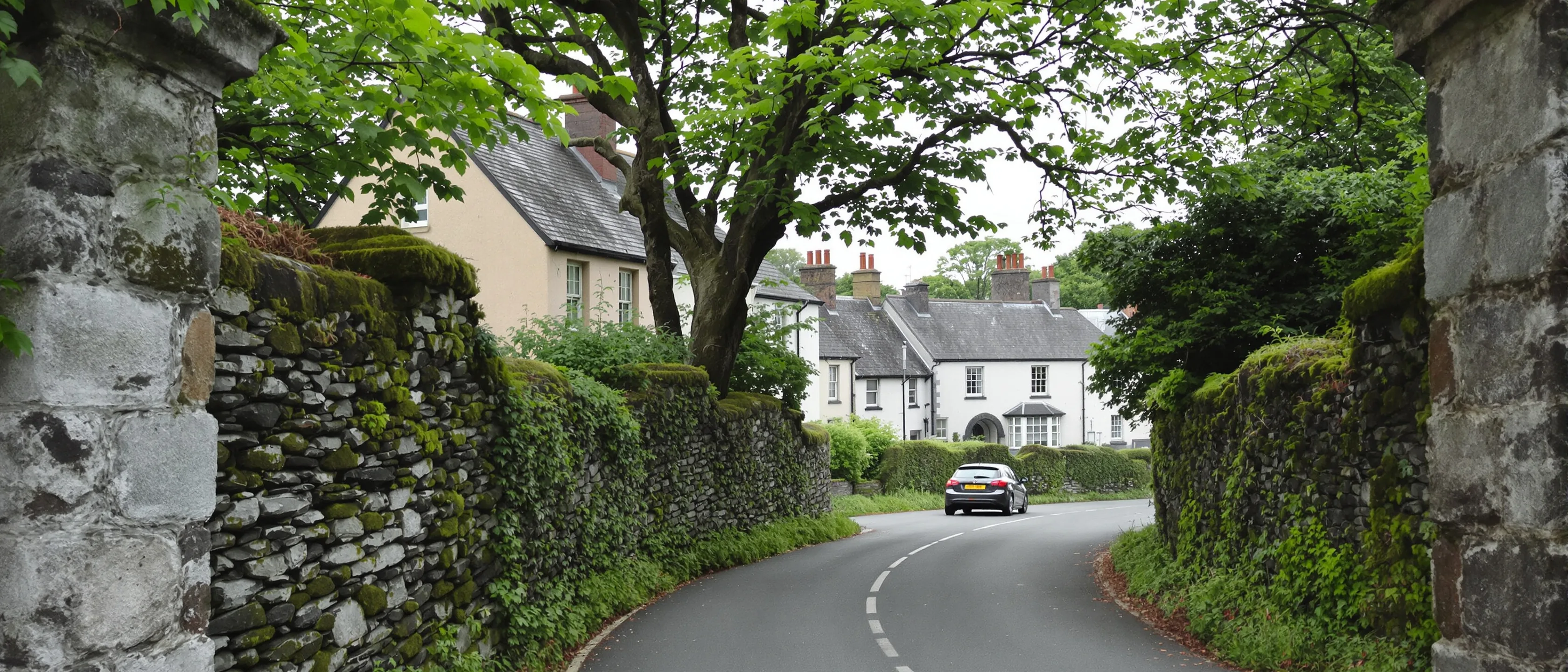
Which leaves the point no form resolves: in Ireland you drive on the left. Coming from Britain, nothing changes for you, and your right-hand-drive car is at home on Irish roads. Coming from Scandinavia or the Low Countries, your left-hand-drive car may come with you; only overtaking on the country roads of the south-east becomes awkward with it, because you have to lean further out into the oncoming lane to see. What bringing your own car costs and how registration works is set out under your car and VRT.
Ask someone who lives there
Marc tells you what a price really means in your area, which school suits your family and in what order to tackle things. You take the steps yourself.